Search This Blog

Showing posts with label Dried Fruit. Show all posts

Sunday, 7 October 2012

Cinnamon Buns

I woke up yesterday with an unmistakeable dryness in my throat and the awful aching all over that could only mean one thing…yep, my first cold of the winter; and it’s only October. Rats!

Comfort food was called for and it had to be something that didn’t involve too much effort on my part. On the cover of this month’s Waitrose mag there’s an enticing picture of cinnamon buns, but the recipe includes an icing that I didn’t like the sound of and it also makes 16 buns…just a tad over the top for the two of us! So, feeling inspired, I unearthed a recipe for an enriched bread dough (which I originally used for hot cross buns) and cheated by doing the kneading and first proving in the bread machine but, if you’re feeling less fragile than me, you could do it by hand. All I had to do was pop the filling in, give them a second proving, whack ‘em in the oven and Bob’s your uncle!

I’m not experienced at yeast cookery, and I’ve never made these before, but I was quite chuffed at how well they turned out – true, they don’t look quite like the ones on the magazine cover, but what you see is what you get; the food in my pictures is actually edible and it hasn’t been prettied up by a food 'stylist'!

½ a sachet of fast-action yeast
250g strong white flour
½ tsp salt
1 tsp sugar
25g butter
110ml milk
1 egg

Filling:
 
25g melted butter
50g soft brown sugar
2 tsp cinnamon
50g dried mixed fruit

a little sugar for sprinkling

If you have a bread machine put the dough ingredients into the bread tin in the order given and set the machine going on the ‘Basic: dough’ setting. When the machine stops follow the steps ** below.

If you’re making by hand, put the dry ingredients and the egg into a large bowl, heat the butter and milk together until barely warm then add to the bowl. Mix with a wooden spoon to form a dough then turn onto a lightly floured surface and knead until the dough becomes smooth and silky; put the dough back in the bowl and cover loosely with clingfilm; leave in a warm place to prove until doubled in size then follow ** below.

** Mix the sugar and cinnamon together in a small bowl. Roll the dough into a rough rectangle about 30cm x 20cm, brush generously with melted butter then scatter over the cinnamon sugar and dried fruit. Roll up tightly, like a swiss roll, from a long side then cut into 9 equal slices.

Put the slices, cut side up, in a 22cm square greased cake tin; cover loosely with clingfilm and leave to prove again until doubled in size.
 
Bake at 200C for 12-15 minutes until golden then sprinkle with a little sugar and cool on a wire rack.

Saturday, 25 August 2012

Moist Fruity Tea Bread

While Mr Simply Veg was trying to beat my new laptop (which I still don’t like!) into submission last week I had a poke around in some of my old handwritten notebooks; they’re full of recipes that I’ve picked up over the years from various sources. Some of them are from magazines and some from friends and family that I’ve scribbled down on a piece of paper and then transferred to my notebooks at a later date. I have to confess I’ve never actually made most of the recipes, but they made good reading.

It’s a Bank Holiday weekend here and raining, unsurprisingly, so it seemed like a good time to bake a little something and resurrect one of the old recipes. This is one that I used to regularly make years ago (when I say ‘years ago’, I mean about 25; blimey, I’m getting old!) but it obviously fell by the wayside for some reason. It would be nice if I could credit the person this recipe came from, but that seems to have been lost in the mists of time and the crevices of my memory.

In my notebook it says serve this tea bread thickly sliced and buttered; I feel butter is a bit over the top, it’s nice and moist from the tea-soaked fruit, but it’s up to you.

By the way, if you’ve got odd bits and pieces of dried fruit in the pantry this is the recipe to use them up. I used just over 300gm of mixed fruit and made it up to 450gm with half a tub of mixed peel and the remains of a bag of dried cranberries. As I’ve said before…waste not, want not.
 
450gm mixed dried fruit
250ml hot tea (without milk!)
100g unsalted very soft butter
1 tbsp marmalade
2 eggs, beaten
175g light brown sugar
450g self-raising flour
½ tsp ground nutmeg
1 tsp ground cinnamon

 
Put the fruit in a large bowl and pour over the hot tea, mix well, cover and leave to steep overnight.

Next day, put the butter, marmalade, sugar and eggs into a large bowl and mix well together with a wooden spoon; add the flour and spices plus the fruit and any tea that hasn’t been absorbed. Mix well, and turn into a 2lb loaf tin lined with baking parchment.

Bake at 160C for 1¼ - 1½ hours and cool on a wire rack.   

Monday, 21 May 2012

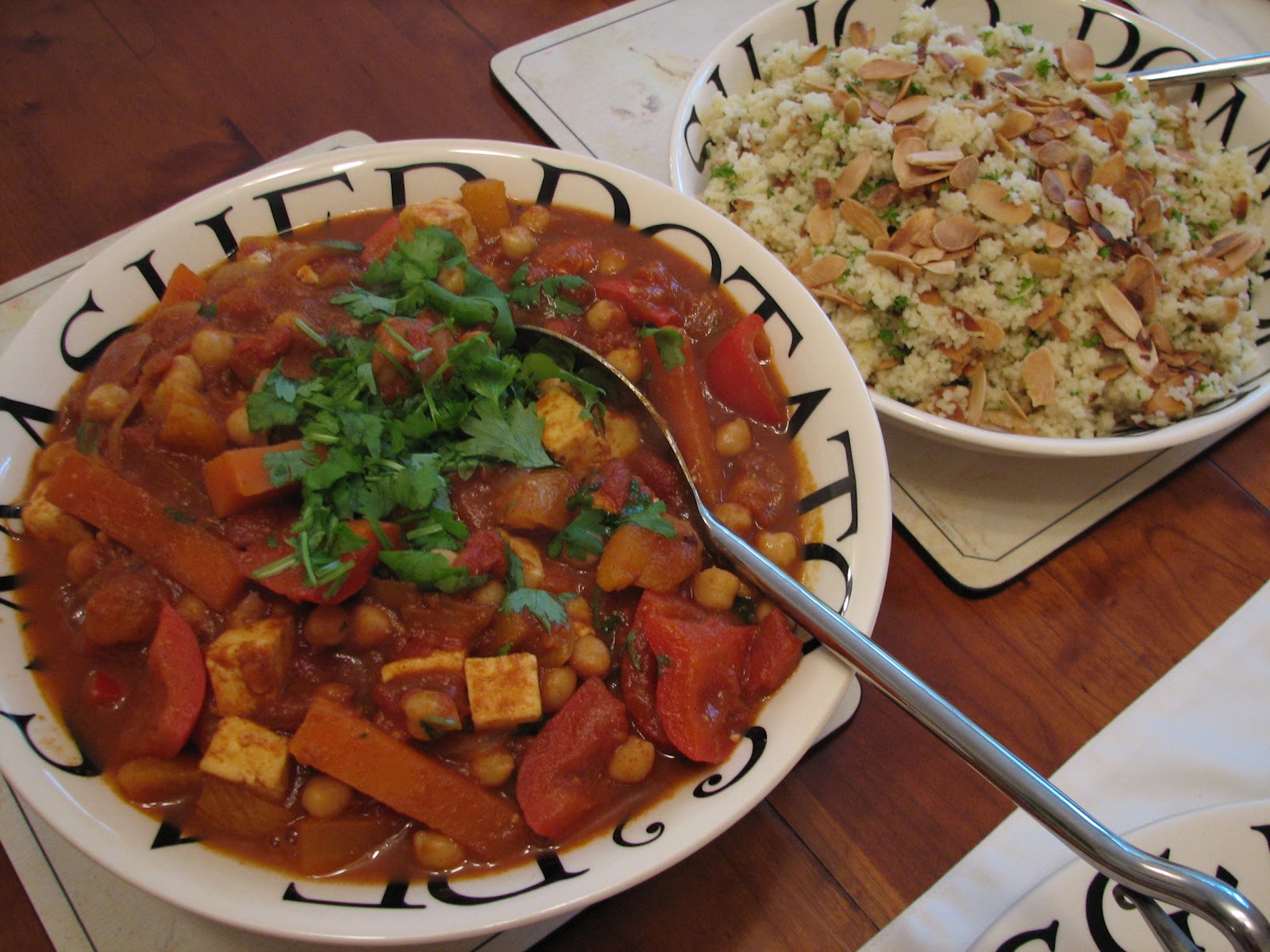
Fruity Tagine with Lemon and Almond Couscous

The weather here has been awful for the last few days, constantly grey and cold, nothing like May should be at all. In a spirit of optimism we planted a whole lot of vegetable seeds last week but it’s been so chilly I’m not entirely convinced they’ll survive. However, there are reports of things warming up a bit later in the week; hmm…I’ll believe it when I see it!

So…what to eat? It’s too cold for light summery meals but I feel heavier winter meals should be over by now. I just didn’t know what to do for dinner last night; it was a case of opening the fridge to see what inspired me.

I finished up making this tagine; I’ve followed tagine recipes in the past that I’ve not been too impressed with, they just didn’t seem to do it for me, so this time I made it up as I went along, adding more of this and less of that to suit our taste. I make no claims as to its authenticity (I know you don’t usually find paneer in a tagine!) but we enjoyed it and I’ll definitely make it again.


2 tbsp olive oil
1 large red onion, peeled and sliced
2 cloves garlic, crushed
2 tsp each of cumin, paprika and cinnamon
½ tsp chilli flakes
1 large carrot, peeled and cut into batons
1 red pepper, cut into chunks
1 tin chopped tomatoes
400ml stock
1 tbsp honey
250g paneer, cubed
1 tin chickpeas, drained
100g dried apricots, halved
handful of chopped coriander

200g couscous
275ml boiling stock
zest and juice of 1 lemon
50g toasted flaked almonds
handful of chopped parsley

Heat the oil in a large pan and fry the onion over a medium heat for five minutes; add the garlic and the spices and cook for a further minute or two.

Add everything else, except the chopped coriander, stir well and bring to the boil; pop a lid on and turn the heat down. Leave to simmer gently for 45 minutes.

About 10 minutes before the tagine is ready put the couscous, zest and juice of the lemon in a large bowl; add the boiling stock, stir once, cover the bowl with a plate and leave for 8-10 minutes. When all the stock has been absorbed, fluff up the couscous with a fork and stir in the toasted almonds and the chopped parsley.

Stir ¾ of the coriander into the tagine before serving and sprinkle the rest of it on top.

Serves 4

Monday, 19 December 2011

Decorated Christmas Cake

Here we are…the finished article! As you can see, I decorated my Christmas cake at the weekend and, though I say it myself, I think it looks pretty good.


I’m not very good at Royal icing; in fact, I don't think I've flat iced a cake in my life. (I can do you a rough snow-scene with the obligatory plastic robin to complete the effect, though!) I don’t much like ready-to-roll fondant type icing, it always reminds me of children’s playdoh in both appearance and taste, so I went for a layer of marzipan with a topping of nuts and apricots with an apricot and brandy glaze; easy but effective.

1 18cm square rich fruit cake
white marzipan
a little icing sugar
3 tbsp apricot jam
1 tbsp brandy
soft dried apricots
whole brazils
whole pecans or walnuts
ribbon

Make the glaze by heating the jam and brandy gently in a small pan until the jam melts, then rub the mixture through a sieve with the back of a spoon. Using a pastry brush, paint the top of your cake generously with the glaze; roll out the marzipan to a depth of about 0.5cm on a surface lightly dusted with icing sugar and cut to size using the base of your cake tin as a guide. Lay the marzipan on top of the cake and brush with more glaze.

Arrange the fruit and nuts on the marzipan, pressing them in lightly (I’m sure you’ll be more artistic than me!) and brush again with the apricot glaze.

Tie a ribbon around the outside of the cake, stand back and feel dead chuffed with yourself!

Store in an airtight tin until needed.

Sunday, 20 November 2011

Christmas Cake II

It’s ‘Stir-up Sunday’ today, the day when people traditionally make their Christmas puddings; we’re not having the usual sort of pud so, instead, I made my Christmas cake.


(I've just noticed that the whole hazelnuts look like little pebbles on the surface of the cake; too bad, no-one will see them when the marzipan is in place!)

Last year I made Nigel Slater’s small fruit cake; it was really nice, good texture and lighter than most rich fruit cakes I’ve tasted. However, we both agreed that a larger cake was needed to last the two of us through December, so I have to confess I’ve fiddled with the recipe a bit and I’ve also scaled it up somewhat to make an 18cm square cake.

I don’t really have a sweet tooth, but I do like a piece of cake with a cuppa of a winter’s afternoon. If I can combine it with a bit of present wrapping and maybe a Christmas song or two on the radio, so much the better!

675g mixed dried fruit (along with the usual vine fruits I included some dried cranberries, chopped preserved ginger and chopped dried apricots)
3 tbsp brandy
2 tbsp Cointreau
grated zest and juice of an orange
190g unsalted butter
100g light muscovado sugar
90g dark muscovado sugar
3 large eggs
100g whole hazelnuts
60g ground almonds
190g plain flour
1 level tsp baking powder
½ tsp ground cinnamon
½ tsp ground nutmeg
brandy for feeding the cake

an 18cm square cake tin or a 20 cm round tin if you prefer
 

Put the dried fruit into a bowl, pour over the brandy and Cointreau, then add the zest and juice of the orange. Stir the fruit well to coat it in the alcohol, cover, and set aside overnight.

Next day, line the cake tin with a double layer of non-stick baking parchment allowing the paper to come 5cm above the rim of the tin.

Turn the oven on to 160C.

Beat the butter and sugars with an electric hand mixer until light and fluffy. Whisk the eggs in a small bowl and add them, a little at a time, to the creamed butter and sugar, beating well after each addition. Add the dried fruit, ground almonds and whole hazelnuts, stirring them in well with a large spoon (don’t use the mixer now, it’ll break up the fruit).

Sift the flour with the baking powder and spices then stir it into the cake mixture, a heaped tablespoon at a time.

Spoon the mixture into the lined cake tin then bake for exactly one hour without opening the door. Turn the temperature down to 150C, quickly place a double sheet of baking paper over the top of the cake and continue cooking for a further 1½ hours.

Test by inserting a skewer into the centre of the cake, it should slide out cleanly, if it looks a bit damp or sticky give it another ten minutes in the oven and test again with a clean skewer.

Let it cool in its tin and, when it’s cold, wrap the cake and its paper in another layer of baking paper and store in an airtight tin in a cool place. Feed it with a little brandy every week till you’re ready to decorate it.

I think I'll do the same as I did last year: no icing, just a layer of marzipan topped with nuts and dried fruits with an apricot and brandy glaze.

Wednesday, 28 September 2011

Spiced Apricot and Apple Chutney

I thought this chutney would be the last one to go on the blog this year, but I have a sneaking suspicion that a small batch of green tomato chutney is also on the cards. We’ve had masses of gorgeous toms from the garden but there are a few which are stubbornly resisting turning red. I've been outside and threatened them….if they won’t behave themselves it’ll be the chutney pot for ‘em!

This particular one was made to use up a lot of bits and pieces that were looking for a home. I had the last couple of cooking apples from the bagful my sister gave me, a Tupperware box of frozen apricots, some very small red onions from the garden that weren’t much use for anything else and half a bag of dried dates which were leftover from something but I can’t remember what!

Twenty minutes of chopping and an hour or so of simmering gave me four jars of a rich, spicy chutney that I suspect will go well with cheese and crackers. My window cleaner said the house smelled lovely...now, be fair, you can't get a better recommendation than that!

I used odds and sods that I had to hand for this but, if you want to substitute plums for apricots or maybe use sultanas instead of dates, just remember to keep the proportions roughly the same and you’ll be fine. Chutney is very forgiving.

225g red onions, chopped
300g bramley apples, peeled and chopped
350g apricots, stoned and chopped
60g dried dates, chopped
2 cloves garlic
1 tsp salt
1½ tsp mixed spice
1 tsp dry mustard
300g soft brown sugar
300ml red wine vinegar

Put the garlic, salt, spice and mustard into a blender with a couple of tablespoons of the measured vinegar and blitz until slushy.

Put the fruits, onions and sugar into a large wide pan, add the garlic and spice mix followed by the vinegar; give everything a good stir and bring to the boil. Lower the heat and simmer steadily for about an hour until thick and no liquid remains when a channel is drawn across the bottom of the pan with a wooden spoon.

Pot up into sterilised jars whilst the chutney is still hot and allow to mature for 4-6 weeks before eating.

Makes 4 190g jars.

Saturday, 3 September 2011

Tomato and Cranberry Relish

...or Tomato and Cranberry Chutney, if you prefer. I’ve decided to call it a ‘relish’ because it’s very slightly smoother than a chutney.

In terms of cooking, I love this time of year; it’s all about squirreling things away for the winter and having lots of nice bits and pieces to eat when the weather’s crabby and you don’t want to go out.


First off the blocks is a new addition to my preserving repertoire; the tomatoes break down during the long cooking to become really sweet and flavoursome whilst the cranberries give it a festive edge. I think it’ll be perfect for adding to a good chunk of bread and a wedge of Brie, a couple of Not Sausage Rolls or maybe a toasted sandwich (or three!)

Talking of tomatoes, I thought you might like to feast your eyes on some of our home-grown beauties. We’ve had such a good crop this year even though the weather hasn’t been great; I can’t believe we grew these stunners from the spindly little plants we put out in the garden in May.

Some people can see beauty in art, but I think I must be a philistine. However, I can see beauty in a basket of tomatoes…Does that make me weird? Yes... probably! To be honest I think there ought to be a law against anything looking this gorgeous!


150g red onions, thinly sliced
20g butter
1kg ripe tomatoes
25g garlic, peeled
25g root ginger, peeled
1 tsp cayenne
1 tsp salt
300g white sugar
300ml red wine vinegar
50g dried cranberries

Cover the tomatoes with boiling water, leave for one minute then peel, remove the cores, and chop roughly.

Put the ginger, garlic, cayenne, salt and a couple of tablespoons of the measured vinegar into a blender and blitz until slushy.

Melt the butter in a large wide pan, add the onions and sauté until softened but not coloured; add the tomatoes, garlic mixture, sugar and vinegar. Bring to the boil and simmer uncovered over a low heat for about two hours, stirring occasionally, until reduced and nicely thick. Add the cranberries for the last 15 minutes of cooking time.

Ladle into hot sterilised jars and leave for 6 – 8 weeks to mature before eating.

(I had a little taste on a spoon and can already tell this is going to be a winner!)

Makes 4 190g jars.

Thursday, 3 March 2011

Welsh Cakes

I'm late; Tuesday March 1st was St David’s day so I should really have made these cakes then. I’m not Welsh, but we once lived in North Wales for a few years and I'm shameless enough to use any excuse for a little treat!

Having said that I’m not Welsh, this recipe most definitely is; it comes from a lady who was born, lived her whole life and died, in a small Welsh mining village: my husband’s Grandmother, Jane. Sadly, she’s been dead now for a number of years but she was a really lovely lady. She brought up a family of six children in a three bedroom miners’ cottage and cooked every meal on a Victorian coal-fired range, although she had a perfectly good electric cooker which was in pristine condition because she never used it!

I hope she’d be pleased at my effort at making her recipe, although I think she’d probably say they needed more spice. I’ll try to get it right next time.

8oz self-raising flour
4oz butter
3oz caster sugar
½ tsp mixed spice
3oz dried fruit
1 large egg
extra caster sugar for dusting

Rub butter into flour, sugar and spice, add fruit then add the egg and mix to a dough. Add a drop of milk if needed.

Roll out dough to ¼ inch thick and cut into rounds with a 2 inch cutter. Grease a heavy frying pan and cook for 3-4 minutes each side. Dust thickly with caster sugar while still warm.

The original recipe was in ounces and I haven’t made any attempt to convert it; if it was good enough for her, it’s good enough for me. I don’t think milligrams had been invented when Jane first started making these!

Sunday, 13 February 2011

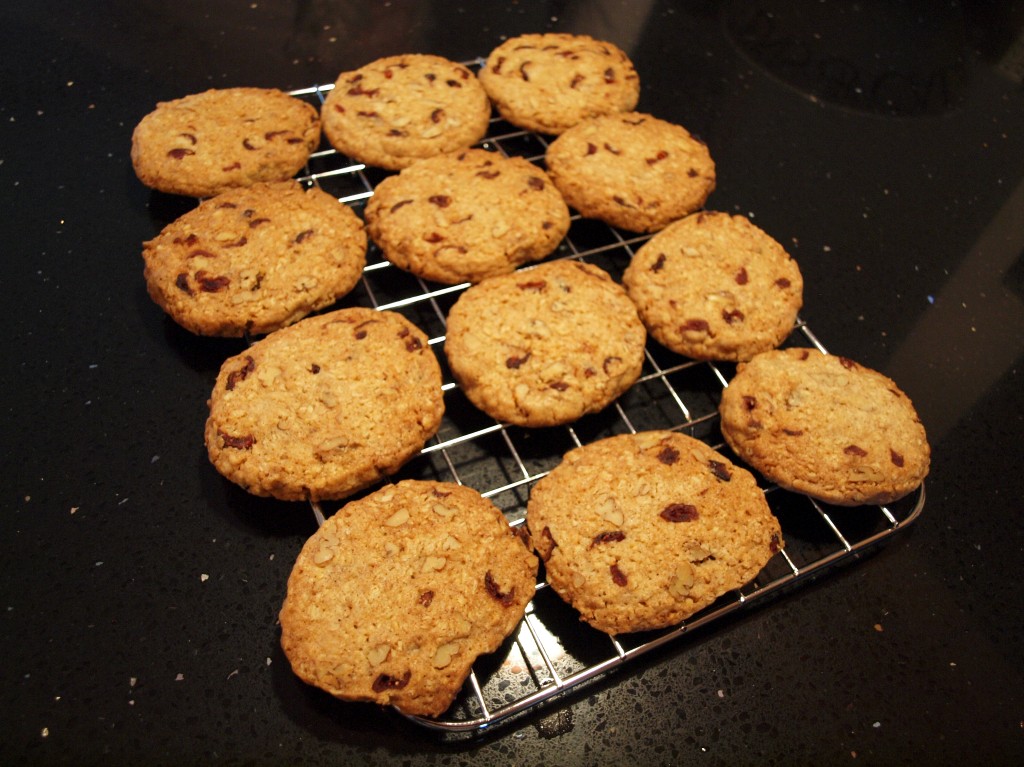
Cranberry Pecan Biscuits

I don’t do a lot of baking and I can’t remember the last time I made biscuits. I don't even make cakes very often but biscuits seem to have passed me by completely. However, I saw this recipe the other day and it looked so easy and quick I just had to have a go. It was obviously one of those ‘meant to be’ moments because, amazingly, I had all the ingredients in the pantry already.

I'm not wild about blueberries so I replaced them with cranberries, but other than that I followed the recipe exactly; I was too nervous to do my usual tweaking, in case I ended up with one big biscuit the same size as the baking sheet! Next time I make them (there will definitely be a next time!) I'll try raisin and walnut or maybe apricot and almond.

Just one point – the recipe says it makes 12, but I made 22 3-inch biscuits from this mix. God knows how big they would have been if I’d only made 12!

Give them a go, they're brilliant and really easy; actually, they'd be worth doing just for the gorgeous warm cinnamon aroma in the kitchen. It was torture waiting for them to cool down, but they were well worth waiting for.

Sunday, 14 November 2010

Christmas Mincemeat

I started making my own mincemeat donkey’s years ago; it’s so simple and so much nicer than shop-bought which is usually far too sweet and syrupy for me. I used to use Delia’s recipe but over the years I’ve sort of evolved my own recipe to suit our taste. I’ve found the addition of preserved ginger really peps up the flavour and I love the citrus tanginess of the extra lemon.

I used a mug for measuring all the ingredients one year because the bowl for my old-style kitchen scale was in the dishwasher; it worked out perfectly well and I’ve stuck with it ever since….if it ain’t broke, don’t fix it!


4 mugs of mixed dried fruit
4 balls of preserved ginger in syrup, finely chopped
½ mug dried apricots, chopped
1 mug veggie suet
1 mug dark Muscovado sugar
1 large Bramley apple, peeled, cored and grated
1 whole nutmeg, grated
grated zest and juice of 1 orange
grated zest and juice of 2 lemons
½ mug of brandy


Mix everything except the brandy in a large ovenproof bowl. Cover with a cloth and leave to stand overnight. Next day put the uncovered bowl into the oven at 110C for an hour. Remove from the oven and allow to cool, stirring occasionally so that the melted suet gets mixed in throughout the mincemeat. Once cool, add the brandy and mix really well again then pot up into sterilised jars.

If you put some dinky little covers on the jars this is nice to give to friends as Christmas gifts.

Sunday, 7 November 2010

Cranberry and Apricot Christmas Puddings

I thought I'd have a go at an alternative Christmas pudding. Not everyone likes the rich, fruity cakes and puds that are traditional at Christmas. There are plenty of different cakes to be found, but a pudding is a trickier proposition; obviously you could choose from any number of desserts, but I do feel that Christmas lunch demands a 'proper' pudding, preferably hot and not just something as an afterthought, to continue the sense of occasion. So, if you have someone in your family, as I have, who won’t touch the usual Christmas Pudding, this could be the very thing.

I couldn’t find a recipe that was exactly what I wanted so I decided to adapt my usual sponge pudding recipe. I thought I’d have a couple of dry runs to get the flavour and texture right and I’m so glad I did…..the first attempt was truly awful! I have no idea what I did wrong but instead of being light, fluffy and fruity they were heavy, doughy and horrible and they went straight into the compost bin!

The second try was (thankfully!) much more successful; I shall definitely be using this one at Christmas. I’ve substituted the normal dried fruit for cranberries and chopped apricots and I've also added a soupçon of nutmeg and some orange zest to give that familiar fragrant Christmassy flavour.

These puds look so cute with their little jewels of cranberry and apricot studding the surface; they taste pretty good, too.

Little Cranberry and Apricot Sponge Puds

175g softened butter
140g light muscovado sugar
1 orange, zest only
2 beaten eggs
¼ tsp freshly grated nutmeg
175g self-raising flour
50g dried cranberries
50g chopped dried apricots

You’ll also need 6 individual metal pudding basins, well-buttered and with a disc of baking parchment in the base.

Place the first six ingredients into a large bowl and mix together – don’t overmix, you want to just combine them until no trace of flour can be seen. Stir in the dried fruit then divide the mixture between the greased tins; cover the tins tightly with a square of baking parchment and a double layer of foil folded well down over the rim.

Place in a steamer and steam the puds for 45-55 minutes. When cooked, run a knife round the edge, turn out and serve with pouring cream or custard.

If you like, cook these on Christmas Eve, turn them out of their tins, allow to cool and put them in an airtight container. Microwave each pudding for about 30 seconds before serving.

Serves 6

Friday, 5 November 2010

Christmas Cake I

It’s that time of year again when Christmas cakes, puddings and mincemeat are on everyone’s mind. I'll post in a day or two about an alternative Christmas Pud and I’ve already made my mincemeat; so that just leaves the cake.

After making a cake every Christmas for about 30 (!) years, in recent years I haven’t bothered. We used to get to the middle of January and still have half a huge cake staring at us, so it kept getting thrown away. Trouble is, I really missed making a cake for Christmas; there’s something about it….soaking the fruit in brandy, grating the nutmeg, double lining the tin… all the silly little rituals that I absolutely love.

So this year I’ve made a cake once again! I’ve always made Delia’s recipe in the past, but I came across a recipe by Nigel Slater for 'A Small, Rich Fruitcake'; the word ‘Small’ jumped out at me…

I rarely follow a recipe to the letter (actually, I rarely follow recipes at all!) but in this case I broke the habit of a lifetime and did exactly as instructed. Things weren’t quite as small as I thought they’d be; in fact, there was so much mixture that I made two cakes in a 1lb loaf tin and a 15cm round tin! However, they look gorgeous and they smell just as they should….of Christmas.

I’m not a big fan of icing so I think I’ll just put a layer of marzipan on the top and then decorate with fruit and nuts and an apricot glaze. In the meantime my little cakes are tucked up snugly in an airtight tin in the pantry, being fed a little brandy from time to time just to keep them happy….


Incidentally, I have a plan to make Christmas last a bit longer this year - I’m thinking in terms of a foodie ‘Advent Calendar’ whereby we have a really nice little something to eat every day leading up to Christmas.

You see, even if you include Christmas Eve, there’s only three days in which to cram all that lovely food so, since there are far too many things I like, the best thing seems to be to spread it over a longer period.

It might be something along the lines of some lovely cheeses, crusty bread and pickles on the 1st; a mince pie and some mulled fruit punch on the 2nd; Not Sausage rolls and homemade chutney on the 3rd; a piece of Stollen with coffee on the 4th…..are you getting the idea?

If enough people spread the word I think this is something that could catch on….well, it certainly will in this house!